
Last updated November 15, 2026
 Wrought iron
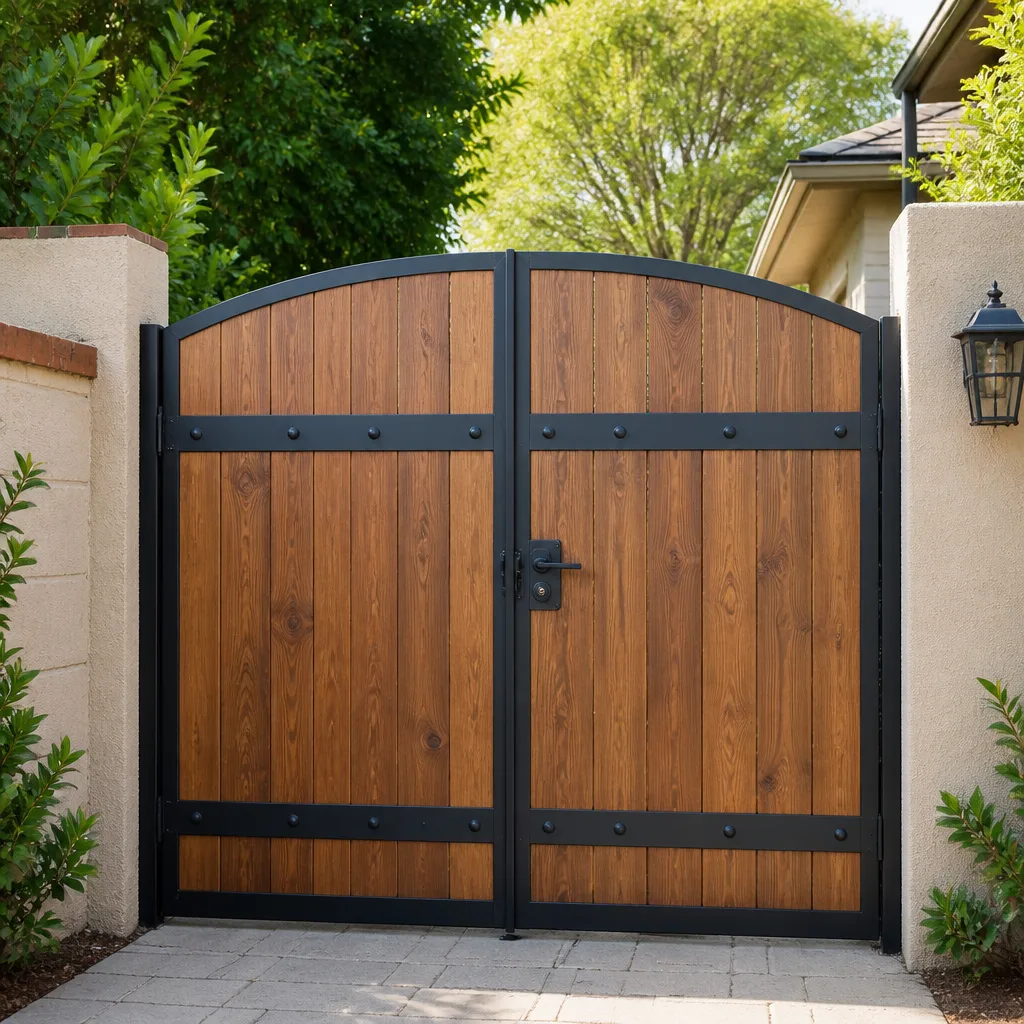 Wood & steel frame
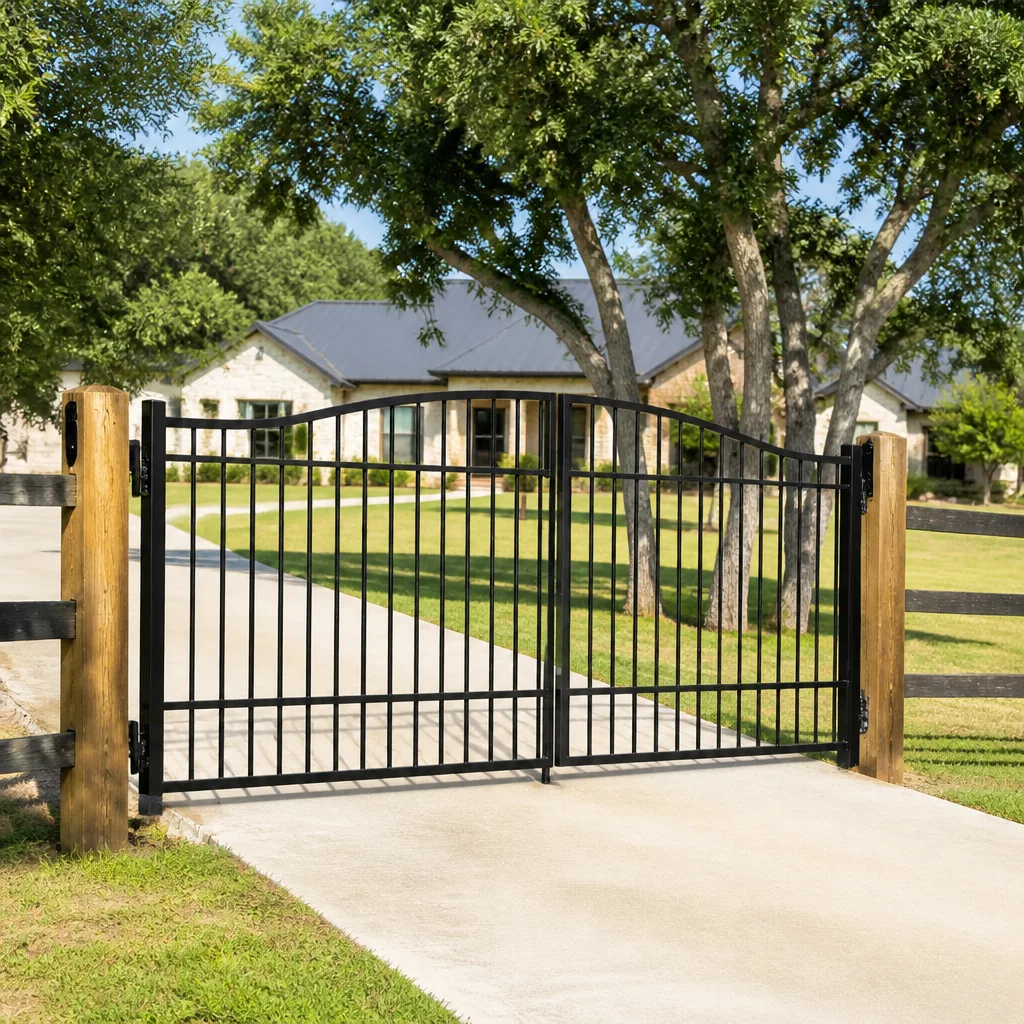 Farm & ranch
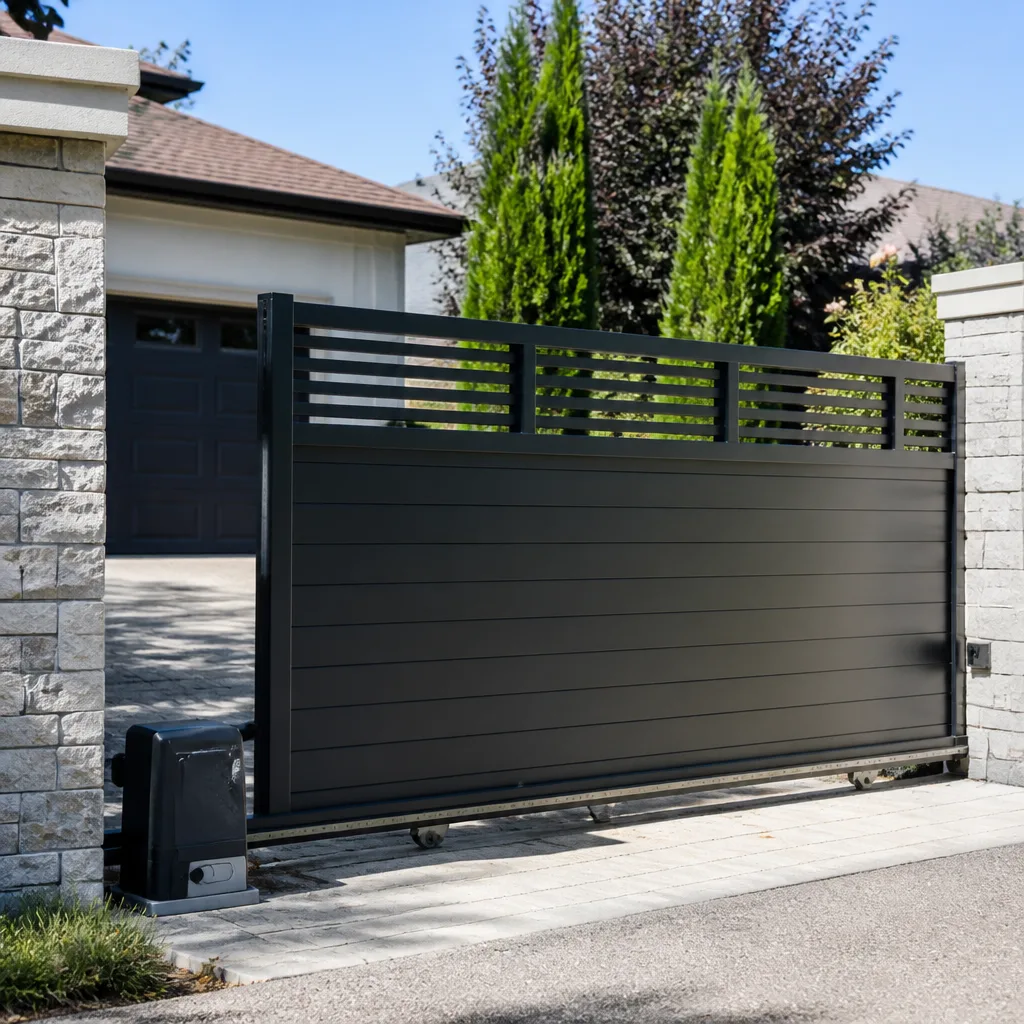 Sliding driveway gates
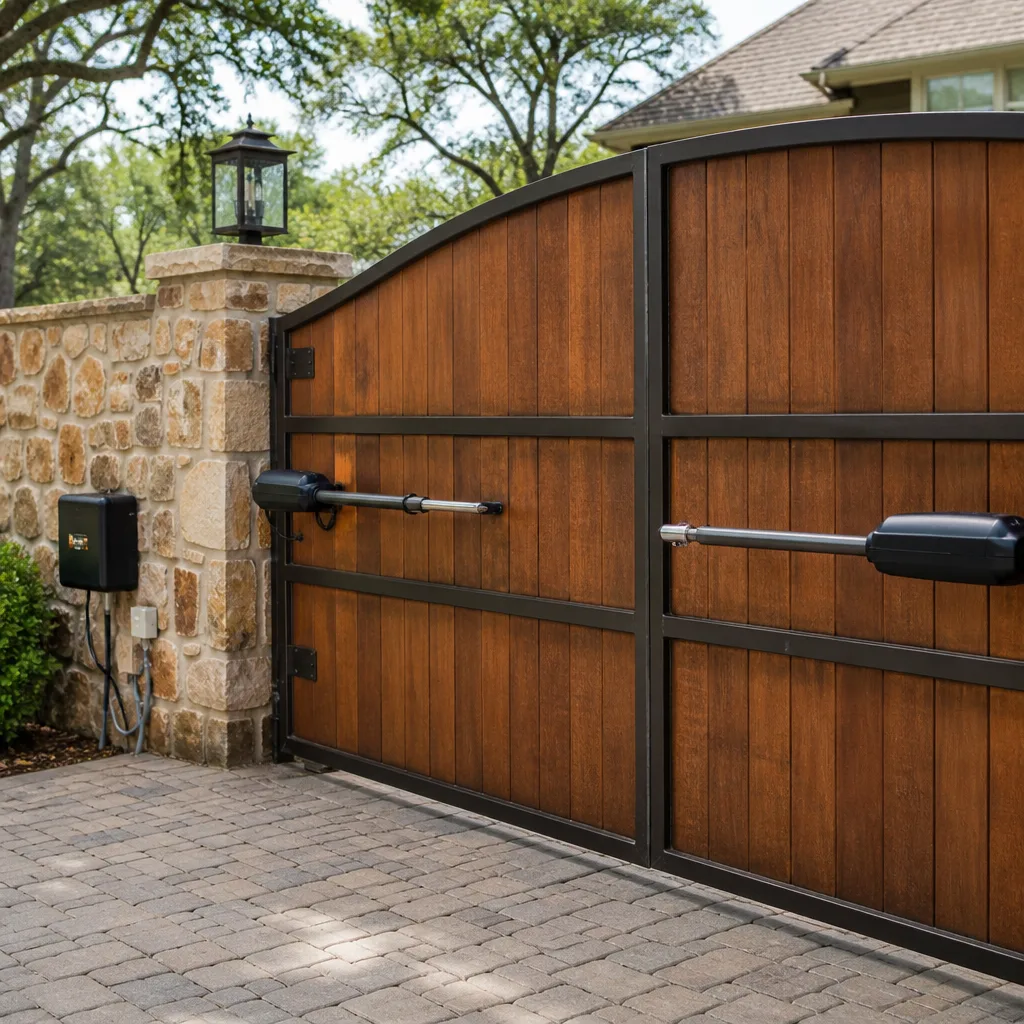 LiftMaster operators
Free on-site gate assessment - hinges, posts, and your LiftMaster or Nice gate operator checked before anything is quoted
The assessment is free and the quote is the invoice.
Get your free estimateGate Repair Emergency Preparedness Guide for Round Rock Homes
Most gate owners plan for the repair and skip the emergency. They know who to call when a hinge squeaks or a remote stops working, but they’ve never asked the question that actually matters at 6am on a workday: what do I do right now if the gate won’t move? That gap is where a minor mechanical fault turns into a locked-in car, a missed appointment, or a driveway standing open to the street. The fix isn’t complicated. A short plan, a couple of documented facts about your operator, and one tested manual release take you from helpless to in control. This guide walks through both emergencies, the release procedures for the operator types common on Round Rock driveways, and what a genuine emergency call actually costs.
Quick Answer
A stuck-open gate is a security emergency; a stuck-closed gate is an access emergency. Each needs a different first response, and both are resolved fastest when you know your operator’s manual release, have your model and serial number on hand, and understand whether your system has working battery backup before the power fails. Most gate emergencies in Round Rock are mechanical, electrical, or power-related, and a trained technician can usually diagnose the cause on the first visit. Call (888) 853-0490 for a free estimate.
Styles & brands we work with
- Wrought iron
- Wood & steel frame
- Farm & ranch
- Sliding driveway gates
- LiftMaster operators
Table of Contents
- The Two Kinds of Gate Emergencies (And Why They’re Not Equal)
- Gate Stuck Closed: The Manual Release, By Operator Type
- Gate Stuck Open: Your First 30 Minutes
- The Pre-Emergency Information Checklist Every Round Rock Home Should Keep
- Battery Backup: The Gap Most Homeowners Don’t Know They Have
- What Emergency Gate Repair Actually Costs in Round Rock
- Storm Season and Central Texas Conditions
- Preventive Steps That Cut Your Emergency Risk
The Two Kinds of Gate Emergencies (And Why They’re Not Equal)
A gate failure sounds like one problem. It’s actually two, and they pull in opposite directions. When the gate jams in the closed position, the property is secured but nobody can get in or out. When it jams open, you can come and go freely but the driveway is exposed. One is an access problem, the other is a security problem, and the correct response to each is not the same.
First responders around Round Rock have dealt with the closed-gate scenario, and it’s the one that catches people off guard. If a household member needs an ambulance and the gate won’t open, minutes disappear fast. Every automated gate owner should know how to operate the manual release, and most have never tried it. That’s the single highest-value item in this entire guide.
The open-gate scenario runs the other way. A gate that fails in the open position leaves the driveway, the vehicles, and the property line exposed. It’s usually not a medical emergency, but it is a security one, and the first 30 minutes matter more than anything that happens afterward.
Here’s the practical difference:
- Stuck closed: priority is getting people and vehicles through. Reach for the manual release first, call for a technician second.
- Stuck open: priority is closing the exposure. Barrier or lock the gate first, call second.
- Partially open or cycling: stop the operator at the breaker, don’t force the leaf, and treat it as a mechanical fault until a technician says otherwise.
Keeping those two cases straight is what turns a four-hour crisis into a twenty-minute resolution.
Gate Stuck Closed: The Manual Release, By Operator Type
Every automated gate has a manual release so the gate can be moved when the operator has no power or has failed. How you operate it depends on the operator type, and the difference between them is real. Below are the three you’ll find on most Round Rock residential driveways.
Articulating Arm Operators
Articulating arm operators mount beside the gate post and push the gate leaf through a folding arm. This is the most common residential setup for a swing gate. The release is usually a keyed manual release cylinder or a lever on the arm itself.
- Locate the manual release key or lever on the arm housing. If you don’t have a key, this is the moment you learn to find it before you need it.
- Turn the release or pull the lever until the arm detaches from the drive position. You’ll feel the arm go slack.
- Move the gate leaf by hand. It should swing freely. If it doesn’t, stop – the fault is in the hinge or the leaf, not the operator.
- Prop the gate in the position you need, then reverse the release to re-engage the arm once the situation is handled.
Underground (In-Ground) Operators
Underground operators sit below grade in a housing under the gate pivot. The drive is buried, and the release is usually a keyed release on the operator housing cover or a release handle that disconnects the drive shaft from the gate leaf.
- Locate the operator housing near the gate pivot. It’s typically at ground level, sometimes under a small cover plate.
- Insert the release key and turn it to disengage the drive. Some models use a release handle instead of a key.
- Test the gate by hand. It should move with light pressure in both directions.
- Before re-engaging, make sure the gate is in a stable position so the drive doesn’t slam back when it reconnects.
Underground operators are the least user-friendly for a first try. If you’ve never located the release on yours, find it today.
Slide Gate Operators
Slide gate motors move a single leaf along a track. Many of these systems include a mechanical release key and sometimes a chain-hoist or a manual hand-crank mechanism for moving the gate when the motor fails.
- Locate the release key assembly on the operator cover.
- Disengage the drive so the gear motor no longer engages the track.
- Push or pull the gate leaf along the track by hand. A slide gate can be heavy and wants to drift – make sure nothing and nobody is in the path before you move it.
- If the gate leaf has come off the track or jammed against the guides, stop. A slide gate can fall, and forcing it is how people get hurt.
One Safety Note on Manual Release
Manual release is a safety feature, but the gate itself is a heavy moving panel. Never reach into the hinge side or the operator during a release, never stand in the path of a slide gate that may roll, and never try to force a gate that won’t move freely with the operator disengaged. If something feels stuck, the fault is in the mechanism, and the safe answer is to stop and call us at (888) 853-0490. We answer 24/7.
Gate Stuck Open: Your First 30 Minutes
A gate that stays open leaves the property exposed. The priority in the first half hour is closing the gap, not fixing the operator. You have a few options, and they’re worth knowing now rather than later.
First thirty minutes, in order:
- Assess the fault. Is the gate open because the operator is dead, because it triggered its safety sensors, or because the mechanism failed mid-opening? A safety sensor that’s been knocked or obstructed will hold the gate open by design. Look for a misaligned photo-eye or debris in the sensor path.
- Check the power. Is the breaker on? Is the operator’s control board showing a fault light? Is the battery backup dead? If the answer is a dead battery or no power, that’s information the technician needs.
- Close it manually. Use the manual release you should already know how to operate and physically move the gate to the closed position. Many operators allow manual closing once the drive is disengaged.
- Lock it in place. If the gate has a manual latch or a gate lock, engage it. A padlock through the latch or a temporary chain can secure the leaf until repair. If the gate has no latch, a temporary physical barrier across the driveway – cones, a length of chain, a folding barricade – keeps the property visually and physically defined.
- Call and schedule. Call (888) 853-0490. We answer 24/7. Fast dispatch from 7am to 7pm, Sunday through Friday. A call outside dispatch hours is booked into the next opening, Sunday through Friday, 7am to 7pm. If the situation is a genuine security risk, tell us that and we’ll work it in.
A gate stuck open in a commercial setting on a Round Rock business property runs the same playbook, but the lock-and-barrier step is usually a call to building security as well. For a business, an open access-control gate is also a records and liability issue, not just a visibility one.
If your gate is open because the motor has failed or the control board is dark, that’s an electric gate issue, and it’s the kind of electric gate repair we handle as a dedicated part of our work. Motors, control boards, safety sensors, access wiring, keypads – it’s all in the trade for us.
The Pre-Emergency Information Checklist Every Round Rock Home Should Keep
The difference between a fast repair and a slow one usually comes down to information. When a technician arrives and already knows the operator model, the serial number, and where the control board lives, the diagnosis starts immediately instead of with a search. Here’s what to document before you need it.
- Operator brand and model. “LiftMaster swing operator” beats “the gate motor” by a mile. We work on the major brands – LiftMaster, FAAC, BFT, Linear, Viking, Ghost Controls, DoorKing, Elite, Mighty Mule – and knowing yours up front speed things along.
- Serial number. Located on the operator housing. Take a photo of the label with your phone.
- Control board location. Is it inside the operator housing, in a separate control box, or on a wall inside the house? Note it.
- Manual release instructions. Find your operator’s release and test it. Write down the process for your specific model and keep it near the keypad.
- Access code and key. If you have a keypad or a code-based entry for gate service, make sure the code is written down somewhere you’ll find it. A technician who can’t get past the gate can’t fix it.
- Power source. Which breaker or circuit supplies the operator. If the operator is on a dedicated circuit, note the breaker location.
- Emergency contact for your gate service provider. Keep the number (888) 853-0490 in your phone and on a card by the main gate control.
- Gate photos. A few photos of the gate, hinges, and operator from different angles save everyone time.
Write it all down on one sheet – a “gate book” – and keep it with the operator documentation. If you’ve never put one together, this is the week to do it.
Battery Backup: The Gap Most Homeowners Don’t Know They Have
The single most common surprise we see is an owner who believes their gate has battery backup and finds out it doesn’t – usually during a power outage that also happens to be the day they need to leave in a hurry. There are two versions of this problem, and both are avoidable.
Version one: no battery backup at all. Many residential operators, especially entry-level units, are shipped without battery backup and installed as mains-only. When the power goes out, the gate stays wherever it was. If that’s the closed position, you’re locked in until the utility restores power.
Version two: battery backup exists but the batteries are dead. Backup batteries age. If the unit is several years old and the batteries have never been checked, they may hold a charge for a few seconds – nowhere near enough to cycle a gate leaf. The owner sees the operator light on and assumes the backup is fine.
Here’s how to know which situation you’re in:
- Check the operator documentation for the words “battery backup” or a battery specification. If you can’t find it, assume you don’t have one until a technician confirms.
- If you do have backup, check the batteries. A healthy backup unit will cycle the gate at least once after the mains are cut. If yours won’t, the batteries are likely at end of life.
- On Mighty Mule and Ghost Controls residential systems, battery backup is a common feature but not universal. Confirm with your model, not with the brand alone.
Central Texas storm season is the reason this matters. A power outage that lasts a few hours doesn’t sound dramatic until a closed gate is on the wrong side of it. Battery backup is the one piece of gate equipment whose value is proven on the worst day.
What Emergency Gate Repair Actually Costs in Round Rock
Here’s what owners want to know first, and it deserves a straight answer. Gate repair pricing in the Round Rock market depends on the fault, the operator, and the parts. The written estimate sets the final price, and the estimate is free – but the honest starting point is that the emergency premium question is more about whether the fault is urgent than about whether it’s a weekend.
How a typical Round Rock gate repair breaks down:
- Diagnostic and service call: included in the free estimate. There’s no diagnostic fee to call us out.
- Minor mechanical repair (latch, hinge, guide roller, sensor realignment): lower end of the range, and often a short visit.
- Control board or motor replacement: the biggest variable. The brand and model of the operator drive the part cost, which is why the pre-emergency checklist above matters.
- Access-control and wiring work: a separate category, priced per job.
- Battery replacement: a small line item, priced per the specific battery for your model.
- New gate installation: outside the repair scope and quoted after a measured on-site estimate.
Emergency repair itself isn’t automatically priced higher. The price comes from the job, and the price you’re quoted and agree to before any work starts is the price you pay. If you’re told otherwise somewhere else, ask for the number in writing before anyone touches the gate. We quote and agree in writing before the work starts, and the free estimate is exactly that – free.
When you’re weighing whether a situation warrants an emergency call: a stuck gate in the closed position during a medical emergency, a commercial property left open during business hours, or a gate stuck open on a property line with no alternate barrier. Those are the calls that justify immediate dispatch. A squeaky hinge, a remote that needs re-programming, or a gate that works fine but looks old can wait for a scheduled visit. Call (888) 853-0490 for an exact quote – estimates are free.
Storm Season and Central Texas Conditions
Round Rock’s weather gives gate equipment a specific set of challenges. Summers are long and hot, the sun hits a metal gate and the operator housing for hours, and sudden thunderstorms bring wind, rain, and power interruptions that hit an operator’s control board and battery backup at the same time.
What that means in practice:
- Power outages are the most common trigger for a stuck gate in Round Rock. The operator loses mains power, and if the backup is dead or absent, the gate stops where it was.
- Heat degrades batteries faster than many owners realize, and batteries mounted in an outdoor operator housing on a sun-facing wall see real heat. A backup that tested fine two summers ago may not cycle the gate today.
- Wind and debris during storm season can knock a photo-eye out of alignment or jam a slide gate’s track. Both will present as an “open” fault until cleared.
- Power surges during storm cells are a real risk to control boards. A surge-damaged board can behave like a mechanical failure – the gate moves partway and stops, or the operator runs but the gate doesn’t move.
If a storm has passed through and the gate is behaving strangely, don’t assume the problem is the motor. Call us, describe what the gate is doing, and let a technician diagnose. We answer 24/7. Fast dispatch from 7am to 7pm, Sunday through Friday.
The mild winters in this part of Texas work in the gate’s favor – there’s no ice expansion cycle to stress hinges or settle the posts. Storm season and summer heat are the real calendar items to plan around, not winter.
Preventive Steps That Cut Your Emergency Risk
Most gate emergencies don’t come out of nowhere. They build up over months – a battery ageing, a hinge wearing, a photo-eye drifting out of alignment – and then a specific event exposes them. A short list of preventive habits keeps that from happening.
- Test your manual release. Operate it while the gate is working so you know it functions. Test it at least twice a year, and test it once right after any repair.
- Check the battery backup. Cut the mains power briefly and confirm the gate cycles on backup. If it doesn’t, that’s the problem.
- Clear and align the photo-eyes. Wipe the sensor lenses, check the alignment, and clear growth and debris from around the sensor line.
- Listen to the operator. A new grinding, clicking, or hesitation sound is information. Note it and call before it becomes a failure.
- Watch the leaf movement. A gate that sags, drags, or hangs on its hinge is putting stress on the operator, and the gate repair will be cheaper if you catch it before the motor takes the load.
- Keep the checklist current. If you replace the operator, update the model number, serial number, and release procedure in your gate book the same week.
- Walk around the gate during storm season. Wind moves things. A quick visual check after a storm catches a misaligned sensor before it strands you.
If your gate has gone beyond preventive work and needs real repair, our gate repair service covers the mechanical side – hinges, latches, guide rollers, arms. For motors, control boards, and access hardware, that’s the electric side. For a gate that’s reached the end of its service life, Round Rock customers call us for new gate installation as well, so the repair-and-replace decision happens with one company. More about what we do Gate Repair Round Rock on the home page.
Common Mistakes to Avoid
- Never testing the manual release. Owners who’ve never operated it discover the key is missing or the mechanism is seized at the worst moment. Test it twice a year, while the gate is working.
- Assuming battery backup is working. A backup unit with dead batteries cycles the gate for two seconds and stops. The light on the operator is not proof the backup works. Test with the mains off.
- Forcing a gate that’s stuck against an obstacle. A slide gate forced off its track can fall. A swing gate forced past a mechanical jam can damage the arm or the hinge. Stop when you meet resistance and call.
- Not knowing the operator model or serial number. In Round Rock, calling without those facts turns a same-day visit into a second trip while we identify the parts needed. Keep the information on file.
- Waiting to call because the gate is “mostly working.” A gate that closes on the third try is telling you something is wrong. Waiting until it fails entirely is what turns a scheduled repair into a real emergency.
- Locking in the wrong place. A padlock through the wrong part of a swing gate or a slide gate can bend the leaf on the next cycle if the operator tries to move it. Lock the gate leaf only after the operator is disengaged.
- Skipping storm-season checks. A post-storm walk-around is ten minutes. A photo-eye hidden behind a fallen branch becomes a gate that stays open overnight.
See the difference
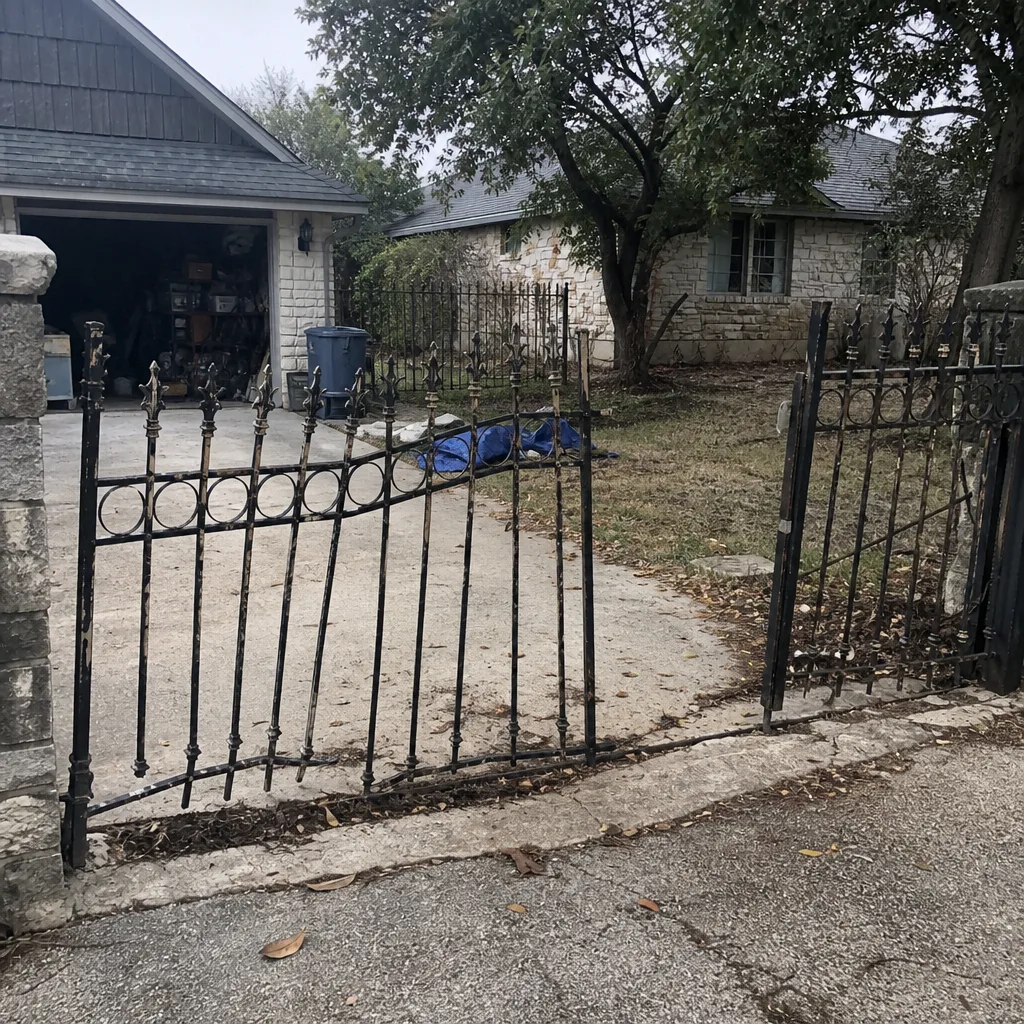 Before
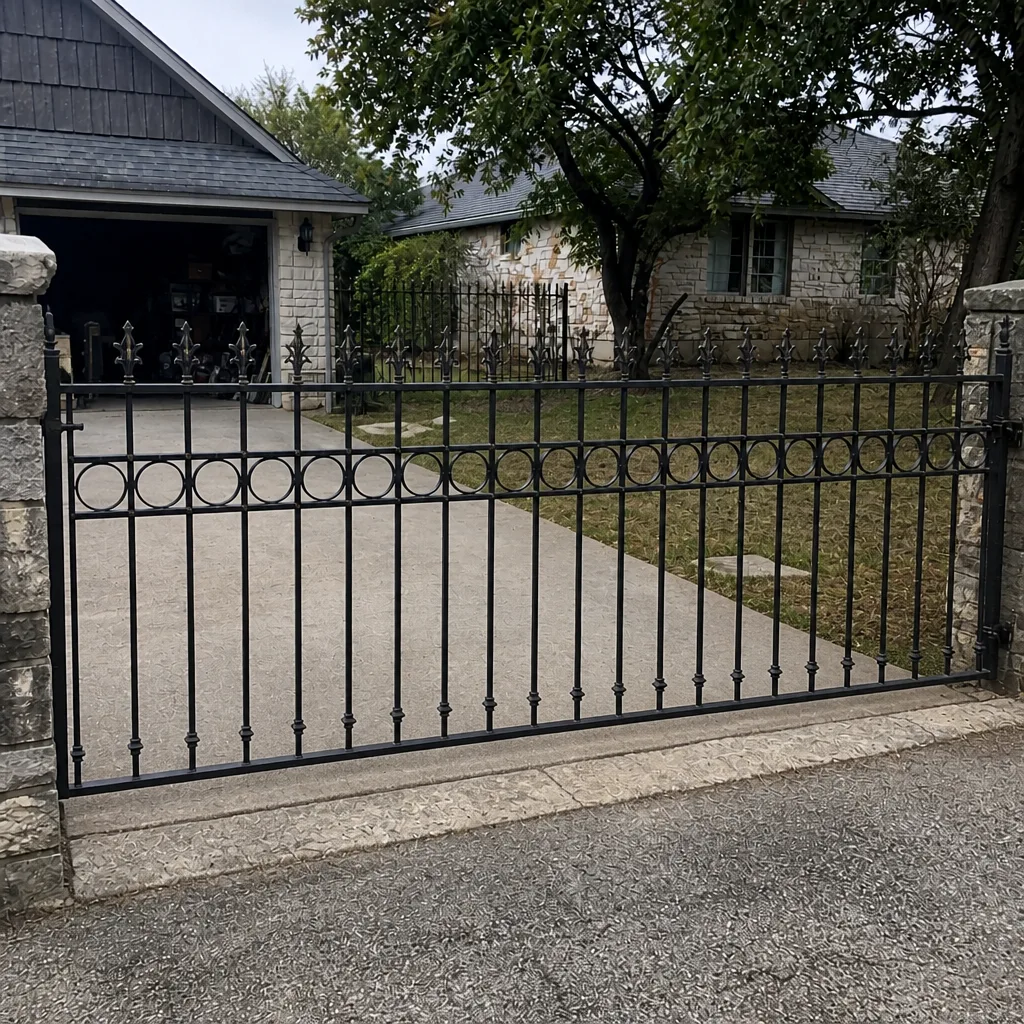 After
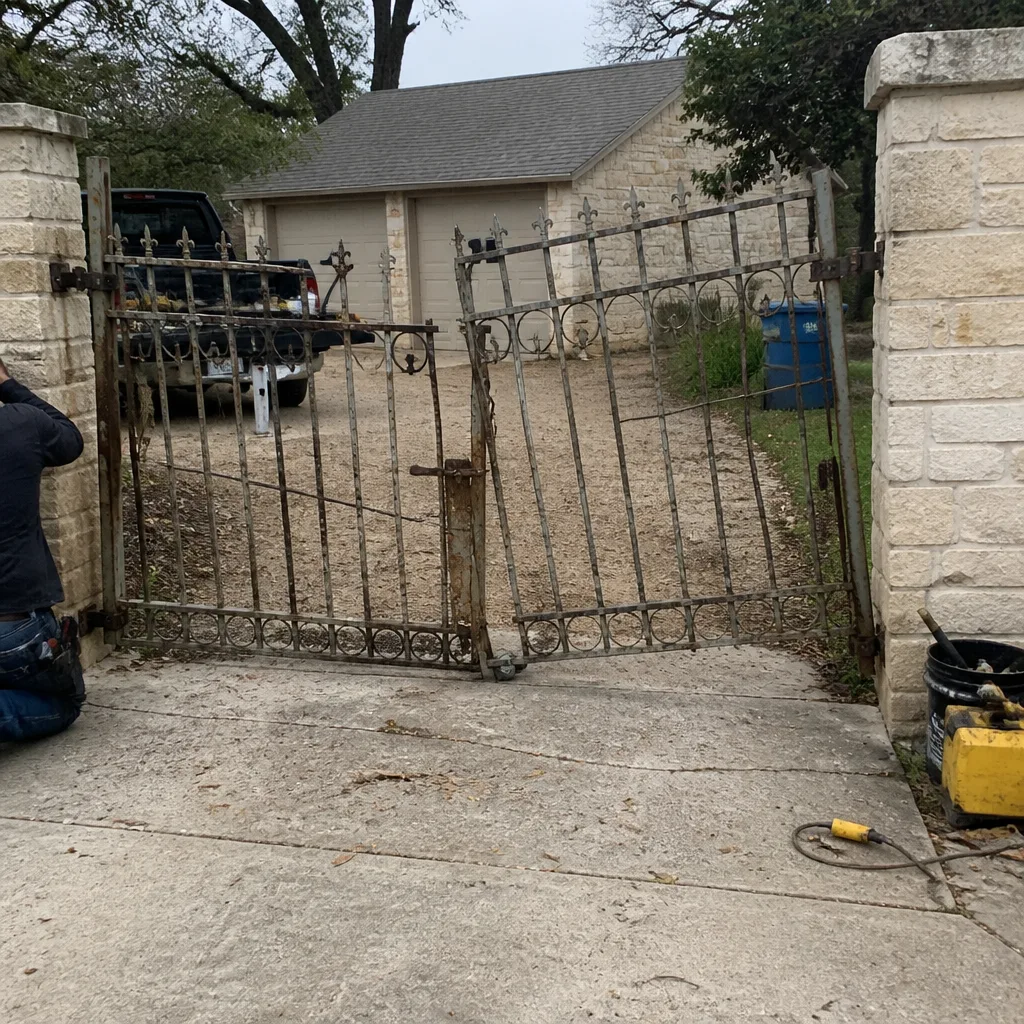 Before
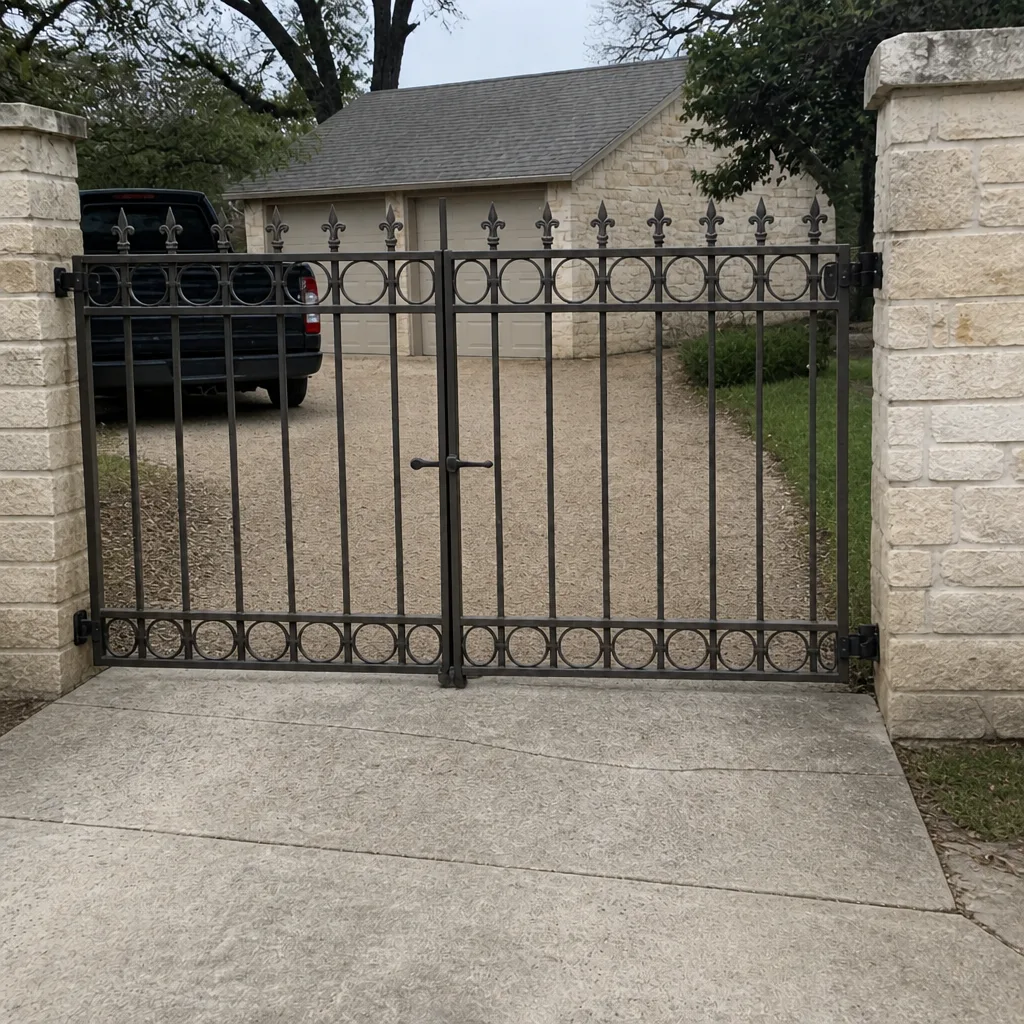 After
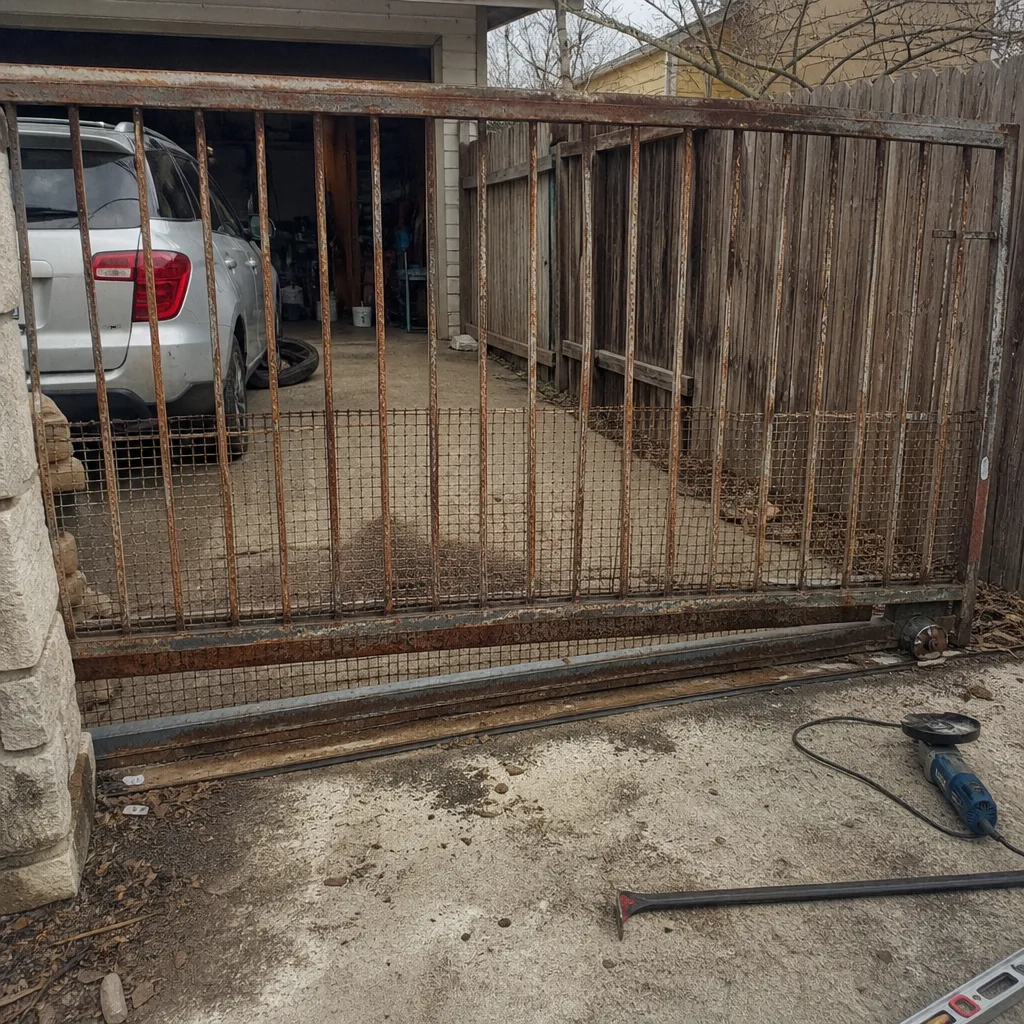 Before
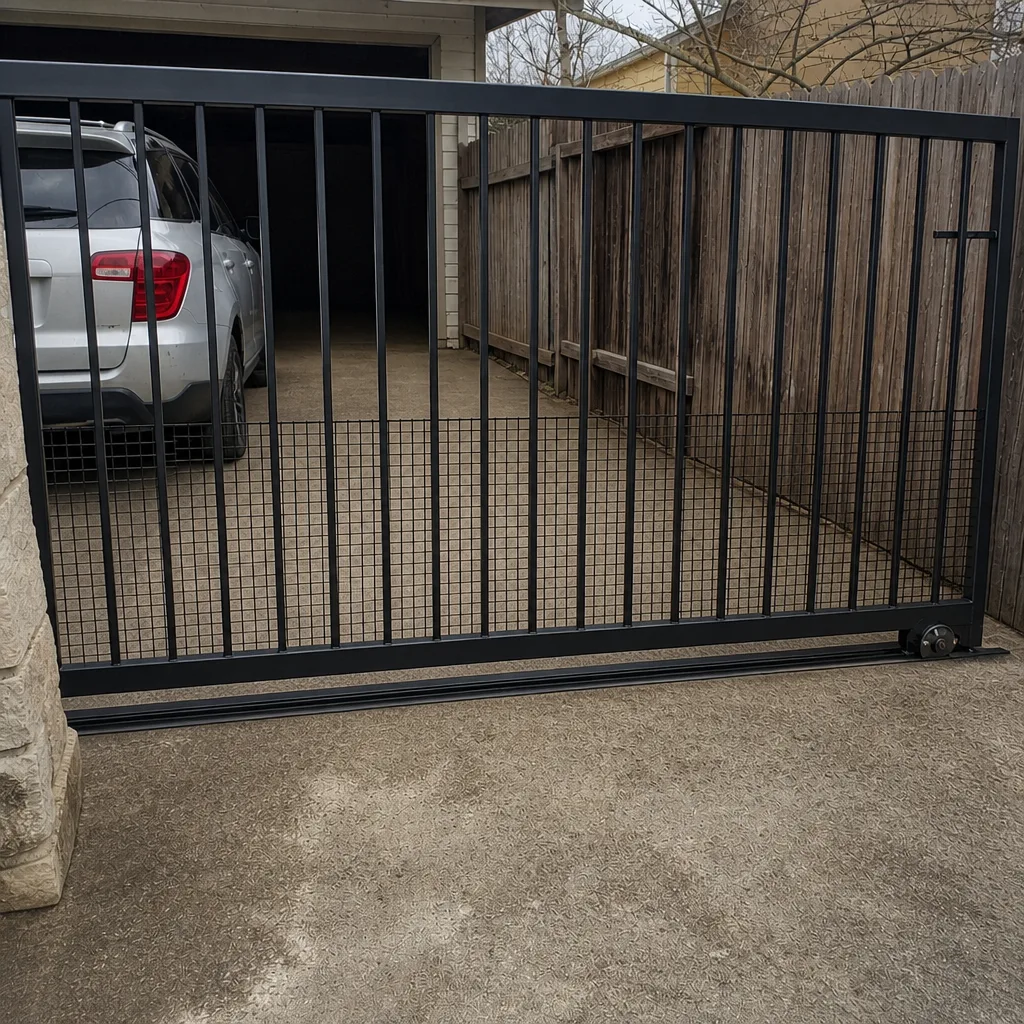 After
When to Call a Professional
Call us for any of the following: the gate won’t open and the manual release won’t free it; a motor or control board that’s dead, cycling, or showing a fault light; a slide gate off its track or a swing gate that’s dropped on its hinge; a photo-eye or safety edge that’s failed and the gate runs regardless of obstruction; access-control or keypad failure; and any commercial gate left open on a property during business hours. Those are the cases where an experienced technician makes the difference. Our technicians have up to 11 years of experience, we work on the major gate and operator brands, and we diagnose before we quote. Gate Repair Round Rock offers free estimates in Round Rock – call (888) 853-0490. We answer 24/7. Fast dispatch from 7am to 7pm, Sunday through Friday.
Frequently Asked Questions
Operate the manual release first, then call for repair. The manual release disengages the operator so you can move the gate by hand. Locate the release key or lever on your operator type (arm, underground, or slide), disengage it, and move the leaf to the position you need. If the gate still won’t move once the operator is disengaged, the fault is mechanical and should be handled by a technician. Call (888) 853-0490 – estimates are free.
Yes, in most cases. When a gate is stuck, exposed, or blocking access, we can often dispatch a technician the same day. We answer 24/7, and fast dispatch runs from 7am to 7pm, Sunday through Friday. A call outside dispatch hours is booked into the next opening, Sunday through Friday, 7am to 7pm. Same-day work is not priced higher than a scheduled repair – the price is set by the written estimate for the job itself.
Check your operator documentation, then test it by cutting mains power and confirming the gate cycles on backup. Many entry-level operators ship without battery backup, and many that have it are running on aged batteries that no longer hold enough charge to move the gate. If the gate stops the moment power is cut, you either don’t have backup or the batteries need replacing. Call (888) 853-0490 for a free estimate.
The price depends on the fault, not on the time of day. A minor mechanical repair – latch, hinge, sensor alignment – sits at the lower end of the range. A control board or motor replacement is the biggest variable, and the brand and model drive the parts cost. The estimate is free, the price is quoted and agreed before any work starts, and the written estimate sets the final price. Call (888) 853-0490 for an exact quote – estimates are free.
Yes, if it’s exposed. A gate stuck open leaves the driveway, vehicles, and property line accessible to the street, and on a commercial property it’s an access-control failure during the hours access matters most. The first 30 minutes are the ones that count – use the manual release to move the leaf, lock the latch or chain the gate, and set a temporary barrier if there’s no lock. Then call us at (888) 853-0490. We answer 24/7.
Likely yes. We service nine gate and operator brands across the residential and commercial spectrum, from Mighty Mule and Ghost Controls to LiftMaster, Linear, Viking, FAAC, BFT, DoorKing, and Elite. We’re brand-agnostic, so recommendations are driven by what’s right for your gate rather than one manufacturer’s program. Tell us the model when you call, and we’ll confirm. Call (888) 853-0490 – estimates are free.
Call a technician. Control boards, motor wiring, and access-control electrical work carry shock and fire risk, and they’re not a homeowner task. This is the electric side of gate work, and it’s a dedicated service for us – motors, control boards, safety sensors, and access hardware. Keep everyone clear of the operator housing and call (888) 853-0490. We answer 24/7. Fast dispatch from 7am to 7pm, Sunday through Friday.
The Bottom Line
A gate emergency is only a crisis when you haven’t planned for it. Know whether yours is the stuck-open case or the stuck-closed case, test the manual release before you need it, confirm your battery backup actually works, and keep your operator’s model, serial number, and control board location in one place. Those four steps turn a panicked morning into a twenty-minute fix. In Round Rock, the weather that most often exposes these gaps is storm season and heat, not winter – so check the equipment ahead of the calendar. If something’s wrong with your gate, call Gate Repair Round Rock at (888) 853-0490 for a free estimate. We answer 24/7. Fast dispatch from 7am to 7pm, Sunday through Friday.
Written by the team at Gate Repair Round Rock.