
Last updated November 15, 2026
 Wrought iron
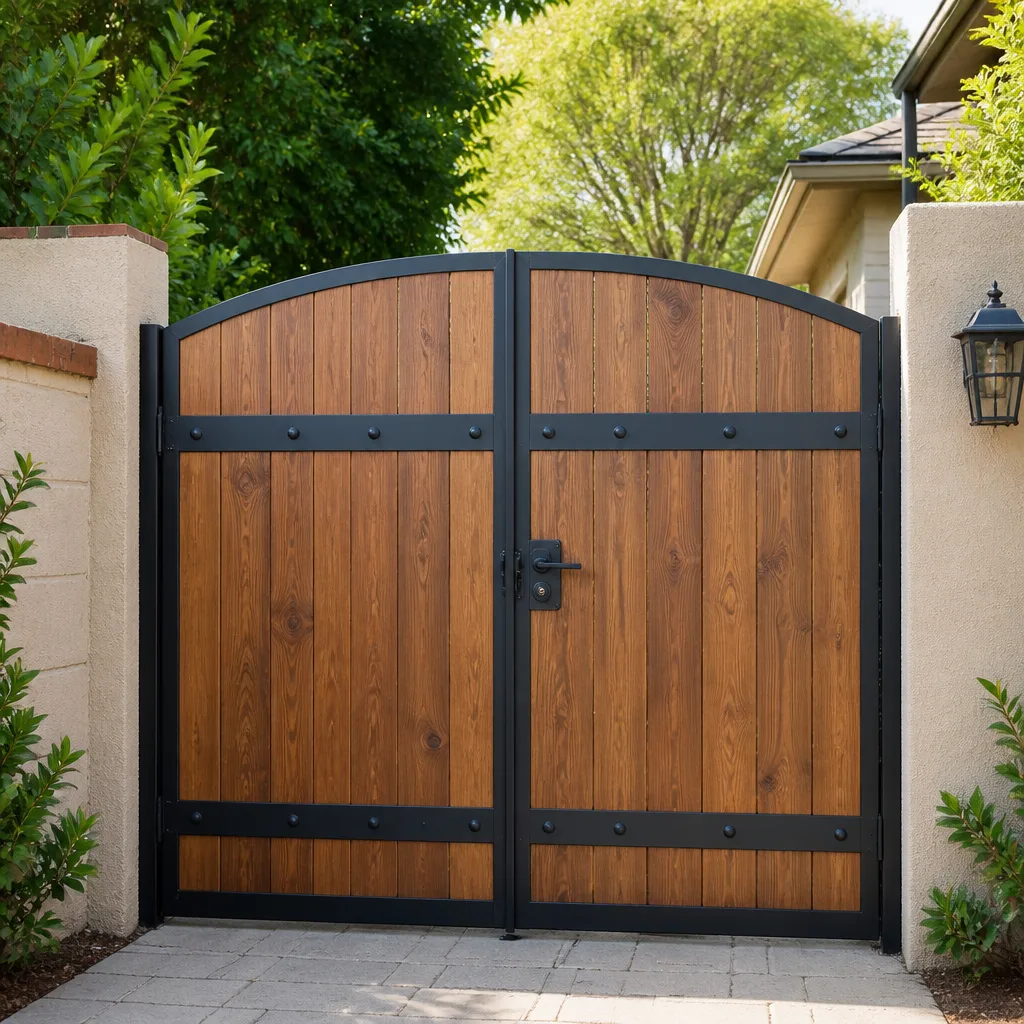 Wood & steel frame
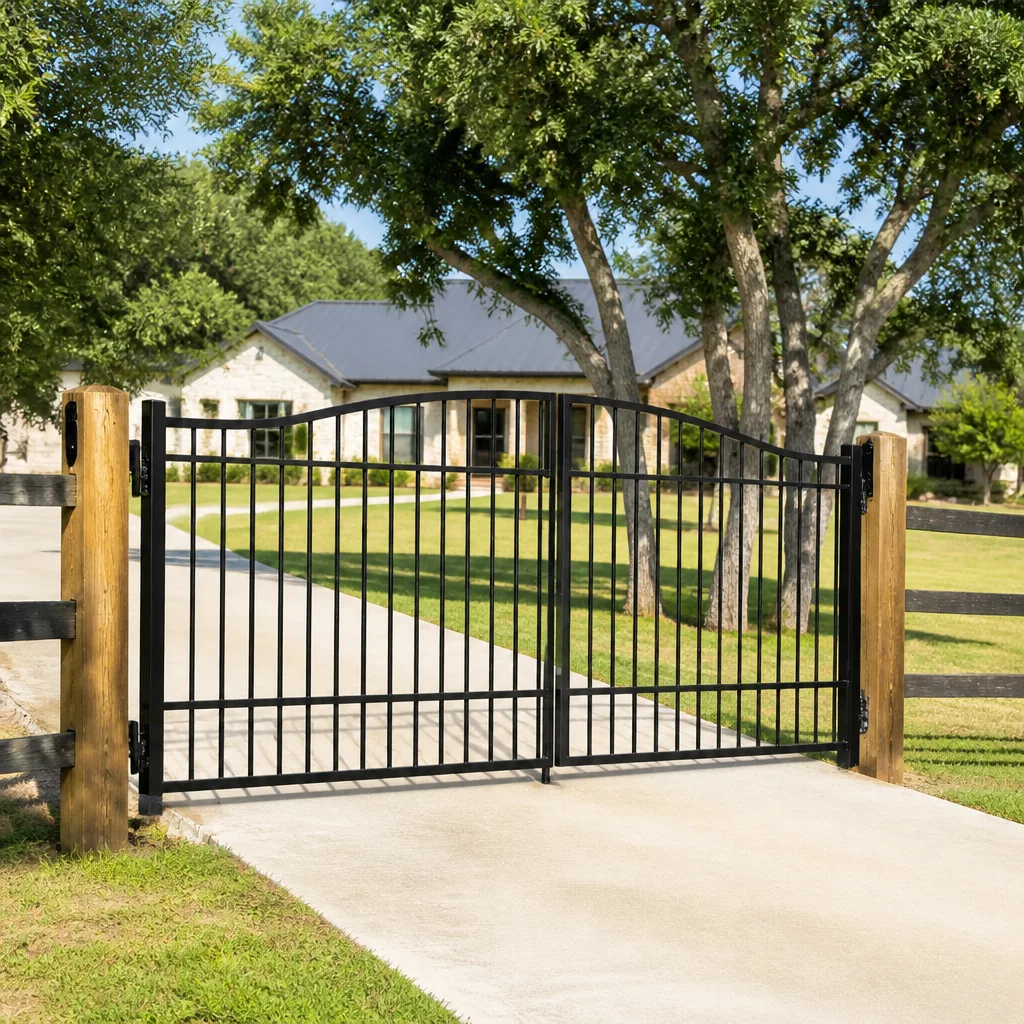 Farm & ranch
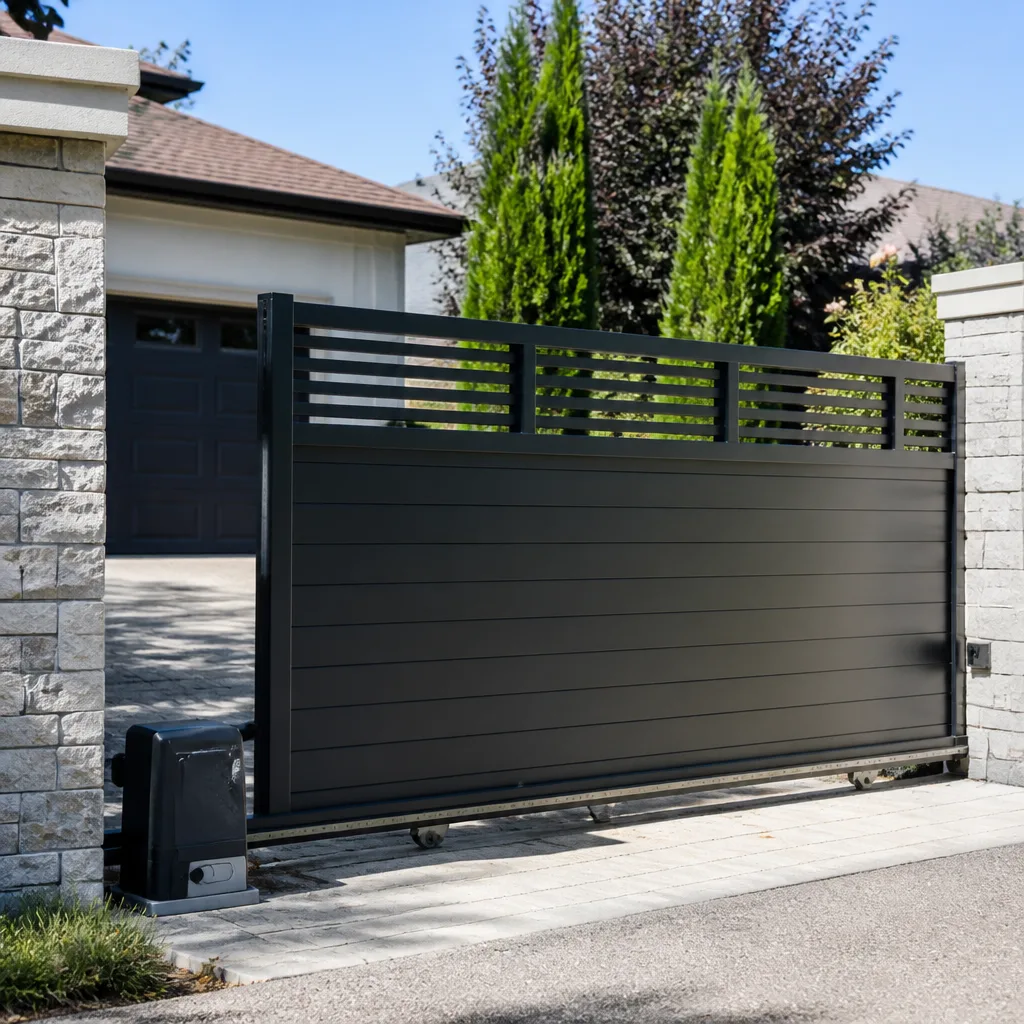 Sliding driveway gates
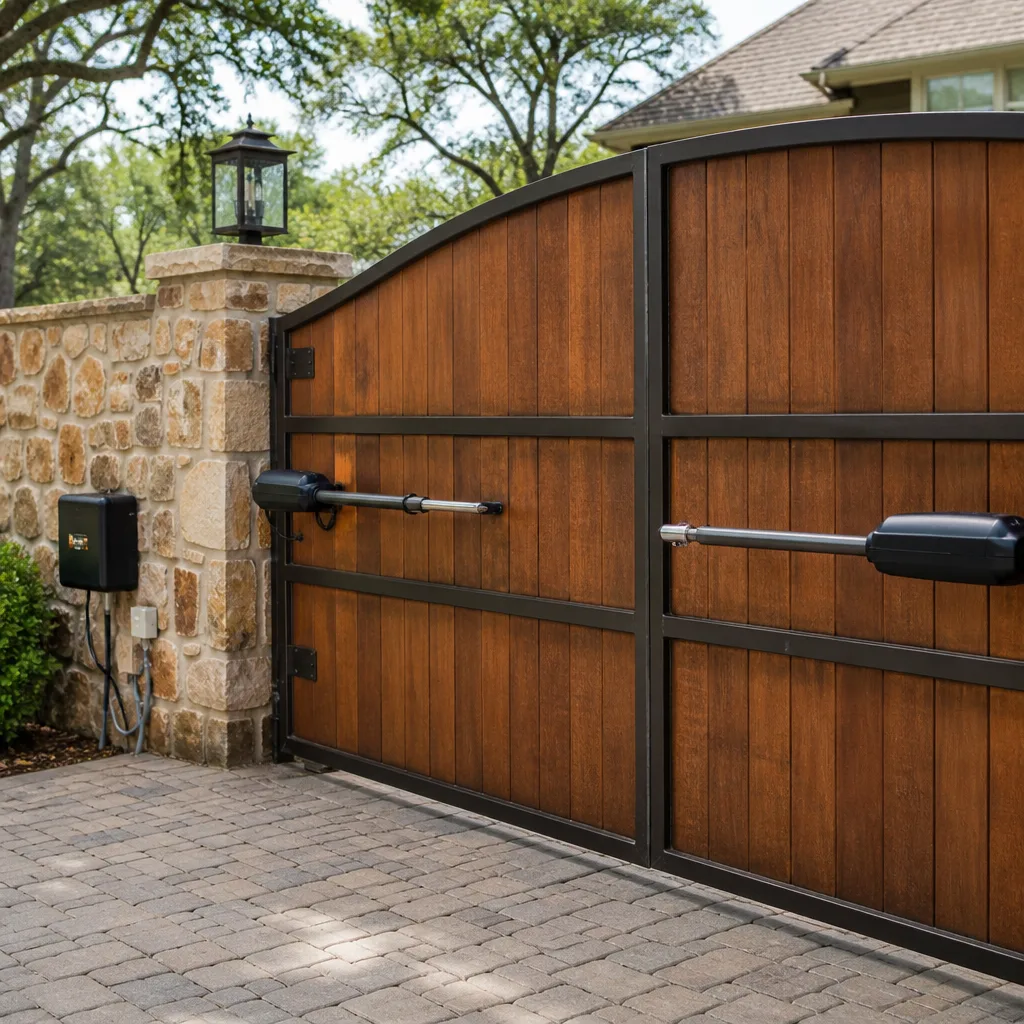 LiftMaster operators
Free on-site gate assessment - hinges, posts, and your LiftMaster or Nice gate operator checked before anything is quoted
The assessment is free and the quote is the invoice.
Get your free estimateDIY vs Professional Gate Repair: The Round Rock Homeowner’s Decision Guide
Replacing a gate hinge is legal, warranty-safe, and straightforward. Rewiring that same gate’s limit switches is potentially a code violation, a warranty void, and a liability problem if the gate later injures someone. From the driveway, both jobs look equally mechanical. That’s the trap. The real question in Round Rock isn’t whether you’re handy enough. It’s whether the specific task crosses into licensed electrical work, voids the operator’s warranty, or knocks your gate out of UL 325 safety compliance. This guide maps the decision task by task, so you know exactly where to stop and call in a gate specialist.
Quick Answer
Mechanical gate work like lubrication, hinge swaps, roller replacement, and minor track realignment is genuinely DIY-viable for a confident homeowner. Anything touching the operator, its control board, safety sensors, loop detectors, access-control wiring, or the 120-volt power feed should be handled by a professional. The dividing line isn’t your skill level. It’s whether the task enters electrical code territory, voids a manufacturer warranty, or affects the gate’s safety reversal compliance.
Styles & brands we work with
- Wrought iron
- Wood & steel frame
- Farm & ranch
- Sliding driveway gates
- LiftMaster operators
Table of Contents
- Why the Decision Is About Task Type, Not Skill
- The Task-by-Task DIY vs Professional Table
- The Texas Electrical Line: Where Low-Voltage Ends
- The Warranty Math Most DIY Guides Skip
- Safety Reversal Compliance and Homeowner Liability
- Where DIY Genuinely Pays Off: Time and Cost Reality
- Round Rock Context: Heat, Soil, and Your Gate
- Brand Specifics: Why Some Gates Are More DIY-Hostile
Why the Decision Is About Task Type, Not Skill
The internet is full of gate repair advice framed around confidence: “If you’re handy, go for it.” That framing is wrong, and it’s how people get into trouble. A homeowner who has rebuilt engines can still void a brand-new operator warranty by opening the control box. A first-time DIYer can safely swap a rusted hinge with a socket set. Competence isn’t the variable that matters. Task category is.
Here’s the useful way to think about it. Every gate repair falls into one of three buckets:
- Mechanical and cosmetic work – hinges, rollers, latches, lubrication, minor alignment. Low risk, no code exposure, no warranty implications.
- Operator-adjacent mechanical work – adjusting arm geometry, replacing a worn drive gear on some models, repositioning a photo-eye bracket. Gray zone. Depends on the brand and whether you have to open the unit.
- Electrical, electronic, and safety-system work – control boards, limit switches, loop detectors, keypads, intercom wiring, the 120-volt feed, and anything affecting reversal force. Professional territory, every time.
That mapping is what this guide is built around. If your task is in bucket one, read on and save yourself a service call. If it’s in bucket three, the DIY math stops working the moment you factor in code, warranty, and liability. We work on Gate Repair Round Rock jobs every week where a homeowner started in bucket one and drifted into bucket three without realizing it. The sections below show you exactly where that drift happens.
The Task-by-Task DIY vs Professional Table
This is the section to bookmark. Below is a practical breakdown of common gate tasks, sorted by whether DIY is genuinely viable or whether a professional should be doing the work. Every task listed either keeps your gate in warranty and code compliance or puts it at risk.
Tasks Where DIY Is Viable
- Lubrication – hinges, rollers, latches, and the operator arm pivot points. A can of lithium grease and ten minutes. Do this monthly in Central Texas and you’ll extend the life of moving parts considerably.
- Hinge replacement – a straightforward bolt-off, bolt-on job on most residential gates. Match the hinge size and gauge to the original, or better.
- Roller replacement on sliding gates – accessible, mechanical, and hard to get dangerously wrong if you support the gate panel properly before removing the old roller.
- Minor track realignment – small adjustments to a sliding gate’s track, tightening loose bolts, clearing debris. Anything requiring the track to be re-set in the ground is not DIY.
- Latch and handle hardware swaps – mechanical, low-risk, no electrical involvement.
- Cleaning and inspecting – checking for loose bolts, rust spots, and debris in the track. This is the most valuable DIY task of all, because it catches problems early.
Tasks Where a Professional Is Required
- Control board replacement – the board is the brain of the operator. Wiring it wrong can destroy it on power-up and definitely voids the warranty.
- Limit switch adjustment or replacement – these set where the gate stops. Get them wrong and the gate drives into a hard stop, damaging the operator or the gate itself.
- Safety sensor and photo-eye work – these are the components that prevent the gate from crushing a person or a vehicle. This is UL 325 territory.
- Loop detector installation and wiring – typically buried or set in concrete, wired into the operator, and tied to vehicle detection logic. Requires trenching, wiring, and calibration.
- Access control integration – keypads, intercoms, fobs, app modules, and commercial access panels. Wiring and programming errors here can lock you out or create a security gap.
- Operator installation or full replacement – the 120-volt connection and UL 325 compliance check make this a professional job without exception.
- Any work on the 120-volt power feed – this is licensed electrical work in Texas. Full stop.
Read those two lists carefully. The line between them isn’t about difficulty. It’s about whether the task can affect the electrical system, the warranty, or a person’s safety. That’s the framework to apply when a repair comes up on your own gate in Round Rock. If you’re already past that line and need a hand, our gate repair service handles both the mechanical and electronic sides of the job.
The Texas Electrical Line: Where Low-Voltage Ends
Here’s the piece most DIY gate repair guides leave out. Texas draws a real regulatory line between low-voltage work and licensed electrical work, and the line doesn’t sit where most homeowners assume it does.
The short version: low-voltage control wiring is generally treated differently from 120-volt line-voltage work. The control signals on an automatic gate – the wires between the operator’s control board and the safety sensors, keypads, and loop detectors – typically run at low voltage (often 12 to 24 volts). The feed from your home’s electrical panel to the operator is not low voltage. It’s standard household current, and in Texas, work on that circuit generally requires a licensed electrician.
Here’s why this matters for a DIY decision:
- If you’re running low-voltage control wire and only low-voltage control wire, many jurisdictions allow a homeowner to do it. Check with the City of Round Rock before you dig or drill.
- If the new wiring requires a new circuit, a new breaker, or extending a run from the panel, that’s licensed electrical work in most Texas municipalities. This is where a lot of DIY installations quietly cross a line.
- If the operator swap involves changing the power supply – a common need when upgrading from a smaller residential operator to a commercial-grade unit – a licensed electrician needs to pull that portion of the job.
- If anything in the process requires a permit – and this varies by what you’re doing and where on your property the gate is – you need the permit before the work, not after.
We’re not giving legal advice here, and we can’t tell you how your specific municipality will treat your specific project. The practical rule of thumb: if the work touches household current in any way, assume a licensed electrician is required until your city’s building department tells you otherwise. Call them, ask the question, get the answer. That five-minute phone call is worth far more than the risk of an unpermitted electrical modification on a gate that can injure a person.
This is one of the reasons electric gate work is its own category in our business and not something we treat as a mechanical afterthought. When your electric gate repair job requires both mechanical work and electrical correction, having one team cover both sides is simpler than coordinating an electrician and a gate technician on separate schedules.
The Warranty Math Most DIY Guides Skip
Here’s a fact that changes the DIY math significantly: most gate operator manufacturers void the warranty on the operator unit if it’s been opened or serviced by an unqualified third party. This is standard language in the warranty documents for professional-grade operators from brands like FAAC, BFT, Linear, and Viking, and it’s there for a reason. Once the case is open, the manufacturer can’t tell whether the failure came from the factory or from what you did inside the unit.
That warranty covers the most expensive component on your gate. A new residential operator is a meaningful investment. A commercial-grade operator, which many access-controlled Round Rock properties rely on, costs significantly more. Voiding that warranty to save a service call doesn’t pencil out in any realistic scenario.
The math looks different depending on task type:
- Mechanical DIY that never opens the operator – warranty risk is essentially zero. Hinges, rollers, latches, and lubrication don’t touch the covered component.
- Mechanical work that requires opening the operator case – warranty risk is real. Even “just adjusting” the limit switches inside some models is enough to void the warranty if the unit fails later.
- Any electronic or control work – warranty is void the moment the seal is broken, assuming there is one. There’s no gray zone here.
In our experience, this is where the “I’ll just try it myself” decision most often goes wrong. Someone watches a video, opens the case to swap a small part, and later the board fails. The manufacturer declines the claim. The repair bill is now on the homeowner, and it’s far larger than the service call would have been.
Brand-agnostic service changes this math in your favor. We work across nine operator brands, so a warranty-safe repair on a Linear unit gets handled the same way as on a BFT unit. There’s no dealership pushing a specific manufacturer. What’s best for your gate is what gets recommended, and the work stays inside the service channel the manufacturer recognizes. Our technicians have up to 11 years of experience across the residential and commercial ends of this trade.
Safety Reversal Compliance and Homeowner Liability
This is the section that matters most, and it’s the one most DIY guides never mention. UL 325 is the safety standard that governs automatic gate operators, and it includes strict requirements for how a gate behaves when it encounters an obstruction. If the gate’s safety reversal force is set wrong, the gate can fail to reverse when it hits a person, a pet, or a vehicle. In some settings it might fail to reverse at all.
Here’s the part homeowners don’t always connect: a gate that “works fine” can still be out of compliance. A gate with a misadjusted safety sensor or a bypassed photo-eye can open and close all day without showing any obvious problem. The problem appears the one time something is in the way.
If you DIY-adjust a safety sensor, a limit switch, or any component that affects reversal force, three things happen at once:
- You lose the manufacturer’s assumption of compliance. The operator is no longer in the condition the manufacturer shipped it in.
- You’ve taken on liability for how the gate behaves in an obstruction event. If someone is injured, the question of who adjusted the safety system becomes central.
- You’ve potentially voided any insurance coverage tied to an improperly maintained automatic gate. Check with your insurer about how they treat automatic gates and what maintenance records they expect.
There’s a specific reason this matters in Round Rock. Gates on residential driveways and commercial access points here run every day. Kids on bikes, delivery drivers, pets slipping through. The gate’s safety system is doing real work every time it moves, and the margin for error is small. A professionally installed or serviced gate comes with a reversal force check and a safety sensor test that confirm the gate behaves as required. A DIY-adjusted gate might not.
The takeaway is simple: safety-system work is not a repair category, it’s a compliance category. Don’t adjust it yourself unless you have a means to test reversal force and confirm compliance after the change. That’s a specialized tool and a specialized skill, and it belongs with a dedicated gate technician, not a general handyman and certainly not a homeowner guessing.
Where DIY Genuinely Pays Off: Time and Cost Reality
Now the honest side of the equation. DIY isn’t just risk. For bucket-one tasks, it’s real savings, and it’s worth naming the numbers.
The one we hear most often is the hinge. A professional hinge replacement typically runs somewhere in the range of $200 total – parts, labor, and the visit. The hinge itself is usually around $35 for a quality replacement. For a confident homeowner with a socket set and a second pair of hands to support the gate panel, that’s a real gap.
Realistic time estimates for the DIY-viable tasks on a typical residential gate:
- Lubrication – 10 to 15 minutes. Do it monthly. No reason to call anyone.
- Hinge replacement – 30 to 45 minutes per hinge, more if the bolts are rusted. Have penetrating oil on hand.
- Roller replacement on a sliding gate – 45 minutes to an hour for a single roller. Support the gate panel before you pull the old one.
- Minor track realignment – 20 to 30 minutes for bolt tightening and small adjustments.
- Latch and handle swaps – 15 to 30 minutes depending on hardware.
The math on all of these leans DIY if you have basic tools and reasonable confidence. The math stops leaning DIY the moment the task involves the operator, the electrical system, or the safety system. We tell homeowners this directly: if it’s a hinge, save the money. If it’s the control board, don’t.
That honest split is also why we’re comfortable quoting free estimates. If we look at your gate and the actual job is a $35 hinge you can swap yourself, we’ll tell you. If it’s an operator issue that’s been hiding behind a hinge problem, we’ll show you what’s actually going on and what the fix costs. Call (888) 853-0490 when you want a professional read on a job that’s starting to feel like more than a Saturday project.
Round Rock Context: Heat, Soil, and Your Gate
Gates in Round Rock live in a specific environment, and it affects which repairs come up and which are DIY-friendly. Three things stand out.
The heat. Central Texas summers are hard on gate hardware. Metal expands and contracts across a wide swing, and that motion loosens bolts, stresses welds, and slowly degrades the seals around operator cases. Lubrication schedules shorten here, and inspections done in spring pay for themselves in summer. Heat is also hard on control boards and battery backups – components that are already at the top of the “professional required” list.
The soil. Much of the Round Rock area sits on expansive clay that holds and releases water. That movement affects gate posts, particularly on sliding gates. A post shift can cause track misalignment that looks like a roller problem but isn’t. Small track adjustments after a wet season are often DIY-viable. Post realignment is not – that’s a footing and concrete problem, and it needs professional measurement before anyone starts cutting.
The housing mix. Round Rock has a wide spread of gate installations, from new construction homes in the newer subdivisions to established properties in and around the older parts of town to commercial access-controlled sites. Each type tends to fail in predictable ways. Newer residential gates often have operators that fail early from board issues or sensor adjustments. Older installations tend to have mechanical wear. Commercial access systems tend to have integration problems with access control or loop detectors. Knowing which one you’re dealing with changes what’s realistic to do yourself.
Wind is worth naming too. Spring storms in Central Texas can drop a limb or blow a panel into a gate track. That’s a mechanical clearing and inspection job, and it’s often DIY-viable – unless the obstruction event has knocked the gate out of alignment or triggered the safety sensor, which pushes it into professional territory. When in doubt, call and describe the problem before you dig in.
Brand Specifics: Why Some Gates Are More DIY-Hostile
Gate operators are not interchangeable, and the brand on your gate affects how much of the repair you should be doing yourself. This matters more than most homeowners realize. Here’s the practical spread.
Entry-level residential operators are typically the most DIY-friendly. They’re designed for straightforward installation and often have user-accessible setup menus and replaceable components that don’t require opening the case. If your gate runs on this kind of system, a light mechanical repair is usually within reach.
Mid-range residential and light commercial operators sit in a middle zone. Some of the adjustments are user-facing, some require professional tools or software. Opening the case is where the warranty question enters, and where the DIY decision should tip toward professional.
Commercial-grade operators – the kind that run access-controlled gates at businesses, multi-family properties, and gated communities – are professional-only territory. The control boards are more complex, the safety systems are more involved, and the integration with access-control hardware requires real expertise. On this tier, our experience with brands like FAAC, BFT, Linear, and Viking is the difference between a repair that holds and a repair that fails again in a month.
Our recommendation is brand-agnostic by design. We work across nine named brands, from FAAC and BFT to LiftMaster, Linear, Viking, Ghost Controls, DoorKing, Elite, and Mighty Mule. That range matters because it means we’re not steering you toward a specific manufacturer. We’re diagnosing what your gate needs based on what’s actually on it. If your specific operator has a known weak point – and most do – we’ve probably seen it across other installations in Round Rock. That’s the kind of pattern recognition that keeps you from chasing a problem back and forth.
Common Mistakes to Avoid
- Opening the operator case to “take a look.” On most brands, the moment the case is open, the warranty is at risk. Look from outside. If you need to see inside, call someone who can do it without burning your coverage.
- Adjusting a safety sensor to stop it from cycling. A sensor that’s misadjusted or bypassed is the single most common cause of a compromised gate safety system. If the sensor keeps tripping, it’s doing its job; it’s telling you something is in the way or the sensor itself has failed. Fix the underlying issue, don’t disable the warning.
- Ignoring heat-related hardware loosening. Round Rock summers work bolts loose in ways northern climates don’t. A loose gate hinge is a five-minute fix now and a bent gate and broken hinge in a month if you skip it.
- Assuming a post problem is a roller problem. When a sliding gate starts dragging, the first instinct is to replace rollers. On expansive clay, it’s often the post that moved. Rollers get replaced, the problem returns, and eventually the real issue becomes a much bigger fix.
- Hiring a general handyman for electrical or safety work. A handyman can swap a hinge. A handyman should not be rewiring a safety sensor or touching the operator’s control board. This is a specialty, not a general repair.
- Running new wiring without checking the permit rules. Adding a new circuit to run power to an operator, or extending an existing run, is regulated work. Call the City of Round Rock before you buy wire, not after.
- Waiting until the gate fails completely. A gate that’s been sluggish, noisy, or occasionally hesitating for a few weeks is a gate that’s telling you something. A $35 hinge and 30 minutes of DIY maintenance now is cheaper than an emergency replacement later, and it’s much cheaper than the liability exposure of a gate that fails while someone is walking through it.
See the difference
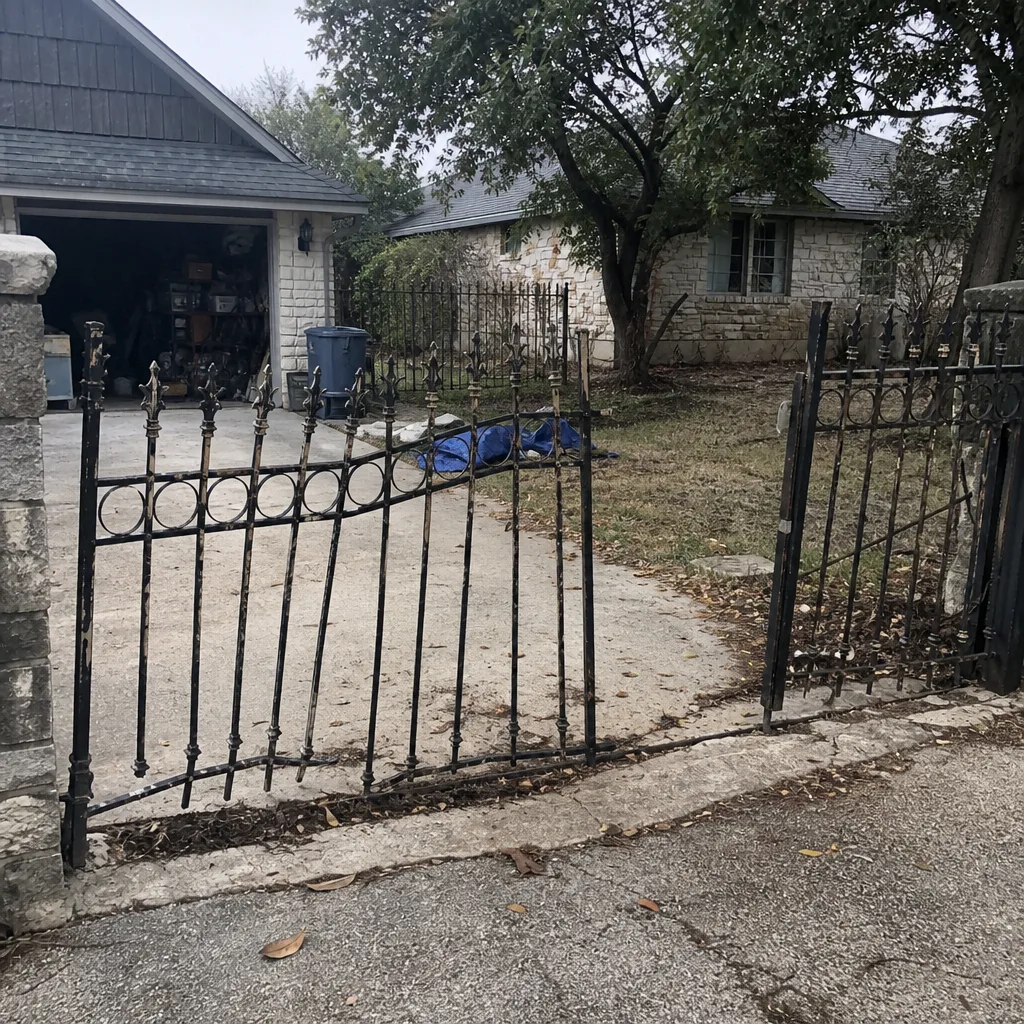 Before
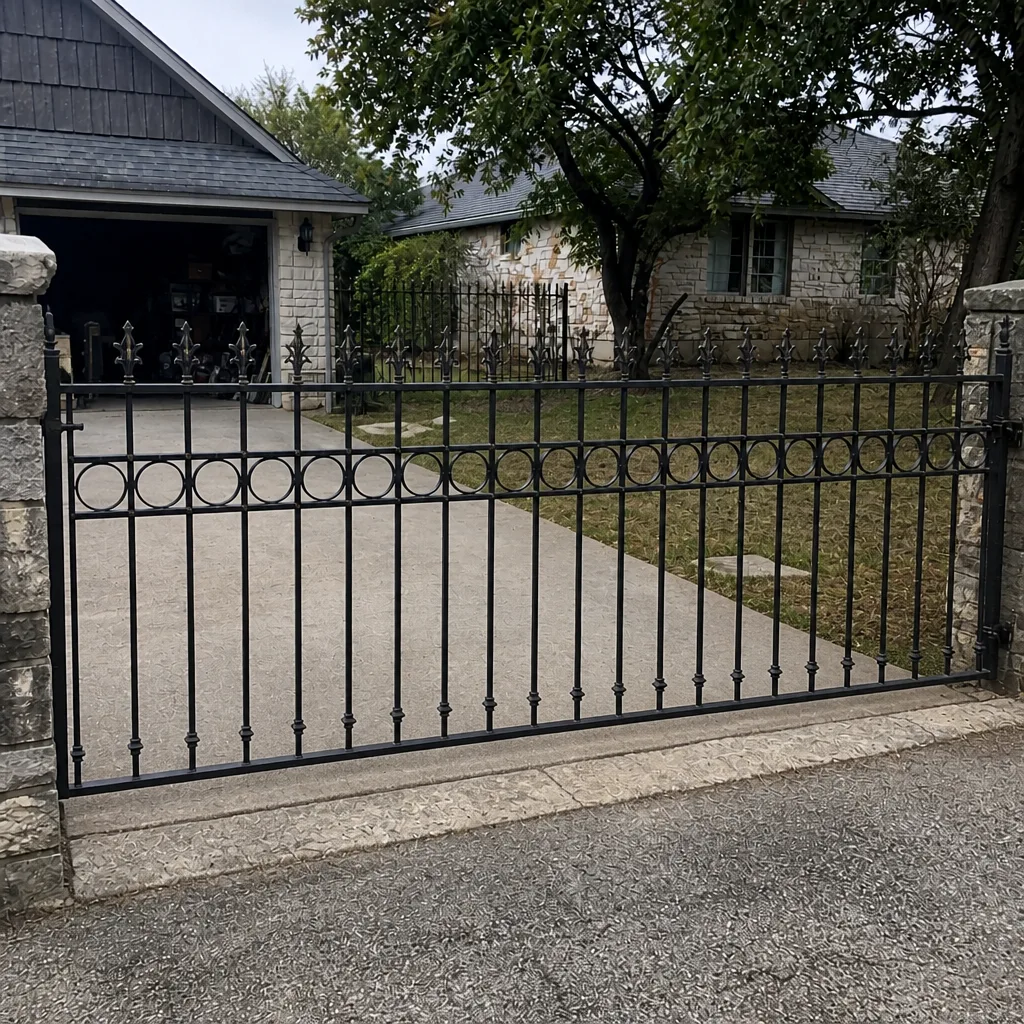 After
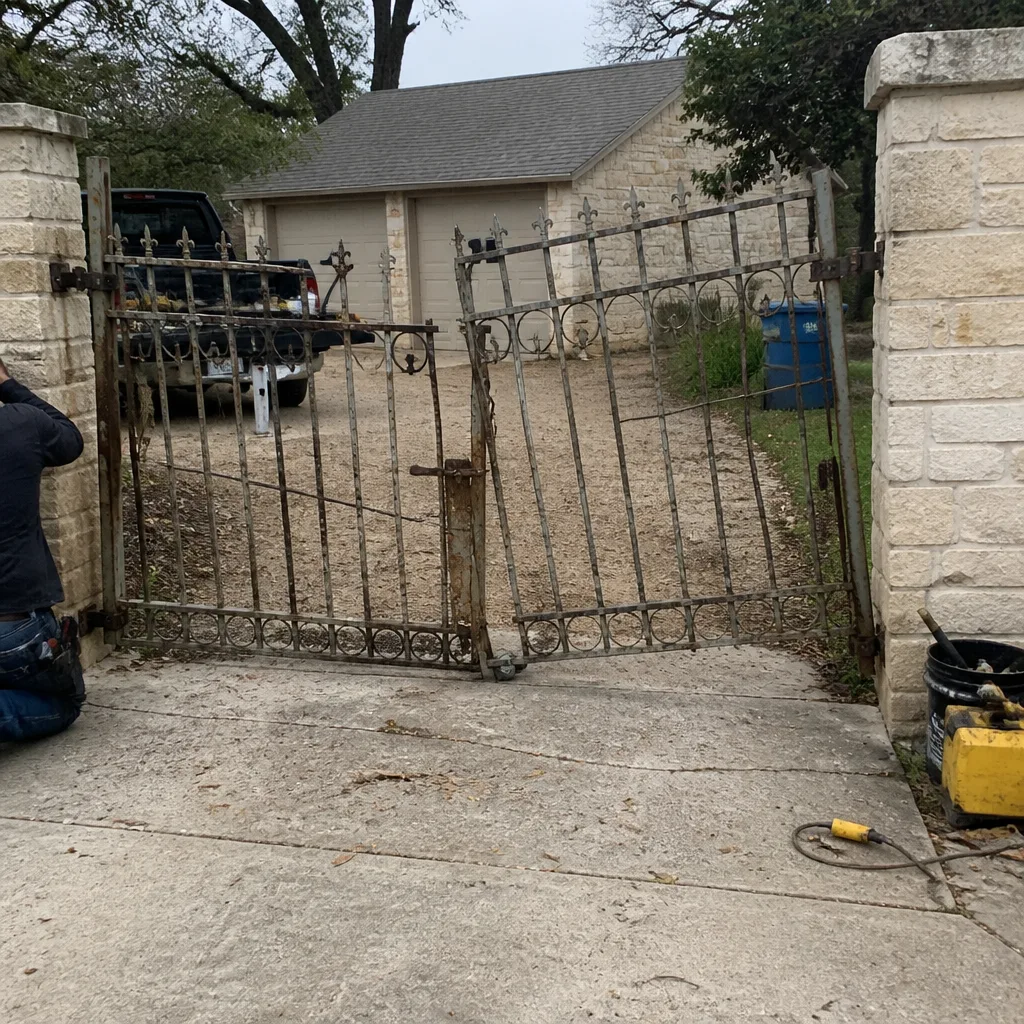 Before
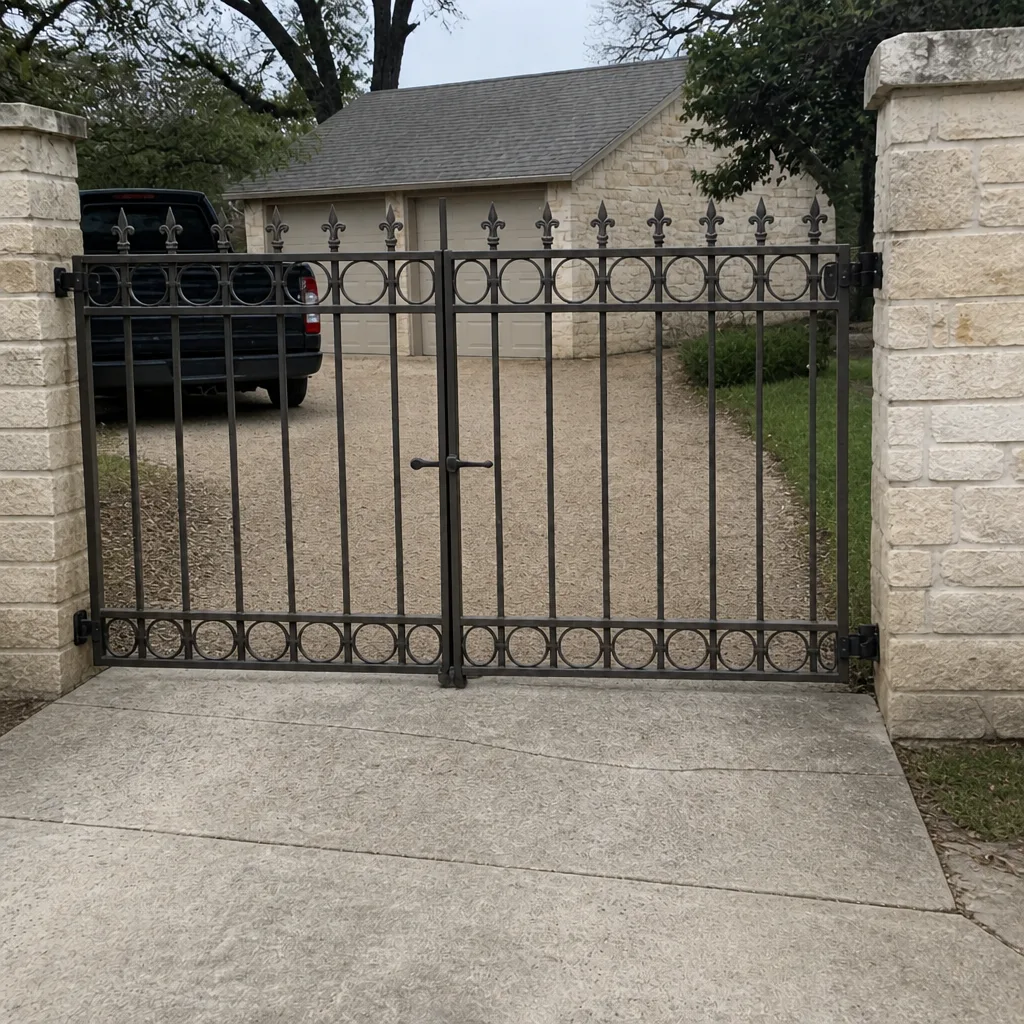 After
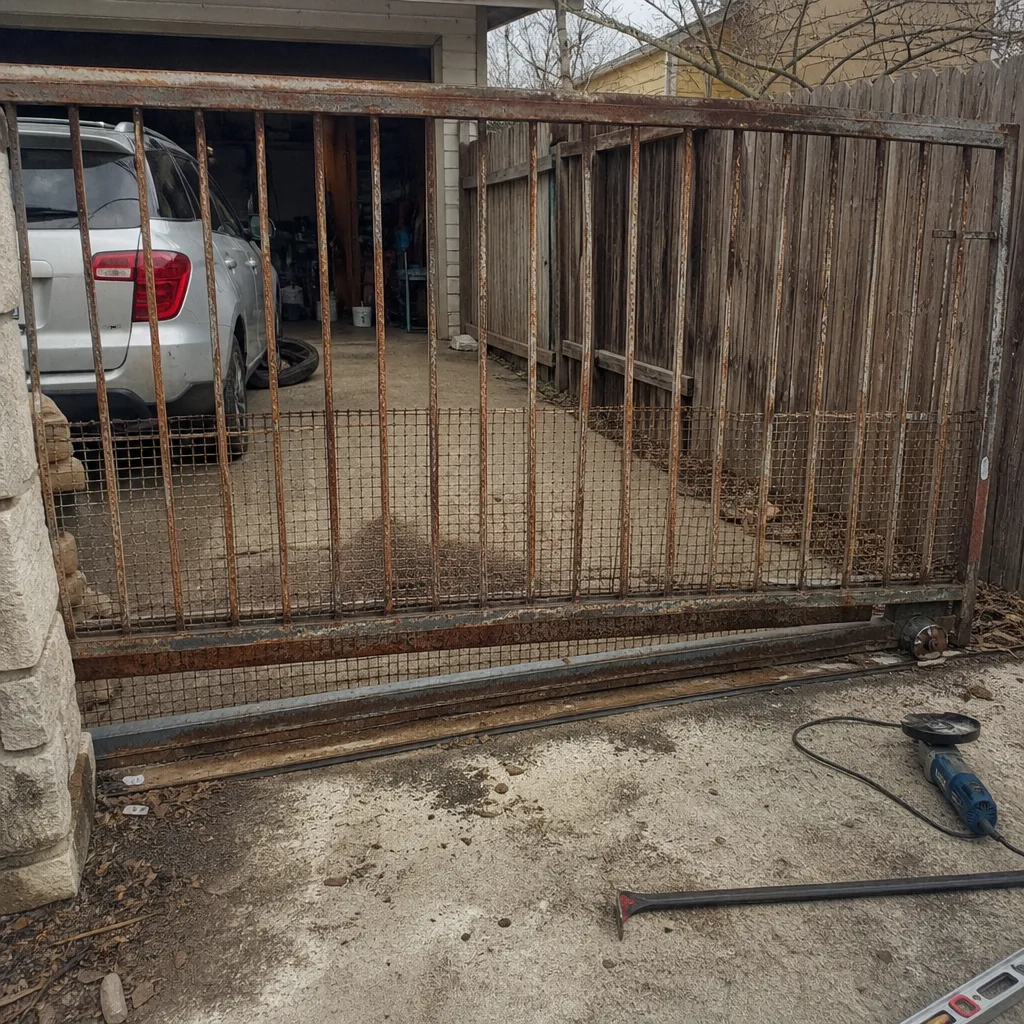 Before
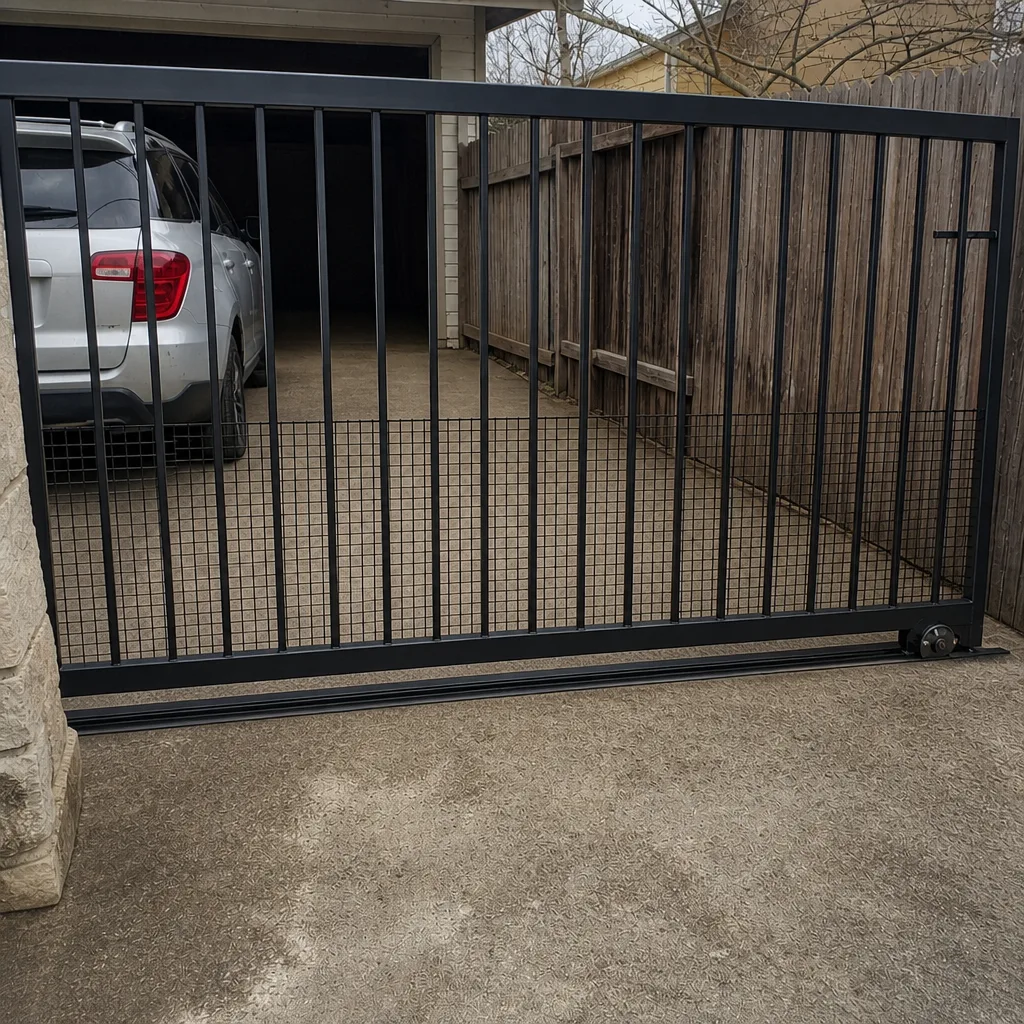 After
When to Call a Professional
Call a professional gate technician when the job involves any of the following: the operator unit, the control board or limit switches, the safety sensors or photo-eyes, the safety reversal force, loop detectors, access-control integration, the 120-volt power feed, post or footing work, or any repair where the case must be opened. These are the categories where DIY costs more than it saves, either in warranty exposure, code compliance, or liability. Also call when a gate that was “just a hinge problem” turns out to involve alignment, or when a mechanical fix doesn’t resolve the symptom after one attempt.
Gate Repair Round Rock offers free estimates in Round Rock – call (888) 853-0490. We answer 24/7. Fast dispatch from 7am to 7pm, Sunday through Friday. Our technicians have up to 11 years of experience, and we work on both residential and commercial gate systems across the brands you’re likely to have.
Frequently Asked Questions
Yes. Hinge replacement is one of the DIY-viable gate repairs, and it’s mechanical work that doesn’t touch the operator, the electrical system, or the safety sensors. Support the gate panel, use penetrating oil on rusted bolts, and match the replacement hinge gauge to the original. If the gate seems misaligned after the swap, that’s a sign of a deeper issue and worth a professional look. Call (888) 853-0490 if you want the job handled instead – estimates are free.
It depends entirely on the task. Mechanical repairs like hinges, rollers, and lubrication are legal for a homeowner. Work on the 120-volt electrical supply to the operator generally requires a licensed electrician in Texas, and many municipalities require permits for gate installations or electrical work. Check with the City of Round Rock’s building department before starting anything involving wiring or a permit. Call (888) 853-0490 for a free estimate if you’d rather not navigate the rules yourself.
Often, yes. Most gate operator manufacturers void the warranty on the unit if it’s opened or serviced by an unqualified third party, and this is standard language across brands like FAAC, BFT, Linear, and Viking. Mechanical work that doesn’t open the case doesn’t usually affect the warranty. Any work inside the operator case is where the risk begins. Call (888) 853-0490 before you open the case – a free estimate beats a voided warranty.
UL 325 is the safety standard for automatic gate operators, and it governs how the gate behaves when it hits an obstruction – including reversal force and sensor requirements. A DIY-adjusted gate can still function day to day and still be out of compliance, which creates liability exposure if something goes wrong. Safety-system work isn’t a repair category, it’s a compliance category. Call (888) 853-0490 for a professional safety check with a free estimate.
A typical hinge replacement professionally runs somewhere in the range of $200 total, covering parts, labor, and the visit. The hinge itself is often around $35. For a confident homeowner, that’s a real savings. For an operator or control board repair, the DIY savings disappear once warranty and liability are factored in, and the professional job is the cheaper path overall. Call (888) 853-0490 for a free written estimate – the price is agreed before any work starts.
Often yes. Same-day service is available for gate repair in the Round Rock area, and fast dispatch runs from 7am to 7pm, Sunday through Friday. We answer 24/7, and a call outside dispatch hours gets booked into the next opening. A gate that’s stuck open or stuck closed is a priority call. Call (888) 853-0490, and we’ll get you back up and running.
The Bottom Line
The DIY vs professional question for gate repair isn’t about how handy you are. It’s about whether the task crosses into licensed electrical work, voids a manufacturer warranty, or affects UL 325 safety compliance. Mechanical work like lubrication, hinge swaps, roller replacement, and minor track realignment is genuinely DIY-viable, and we encourage you to do it. Anything touching the operator, its control board, safety sensors, loop detectors, access-control wiring, or the 120-volt feed should go to a dedicated gate technician. That line is the whole guide in one sentence. Apply it task by task, and you’ll know exactly when to pick up a wrench and when to pick up the phone.
Gate Repair Round Rock handles gate repair, electric gate repair, and gate installation for residential and commercial customers. Our technicians have up to 11 years of experience across nine operator brands. Call (888) 853-0490 for a free estimate – we answer 24/7, and fast dispatch runs from 7am to 7pm, Sunday through Friday.
Written by the team at Gate Repair Round Rock.